Thousands of individuals work at distribution centers along the Grant Line Road and I-205 corridor, teach in Tracy Unified School District classrooms, look after kids in neighborhood daycare centers, or work in the emergency room at Sutter Tracy Community Hospital on any given weekday in Tracy. At some time, a lot of them will be required to finish a CPR and First Aid training. This article explains what the training involves, how the requirement appears in various Tracy workplaces, and how to select a course that aligns with your employer’s or program’s genuine needs. It is written for those employees, students, and families.
A Two-Part Skill Set
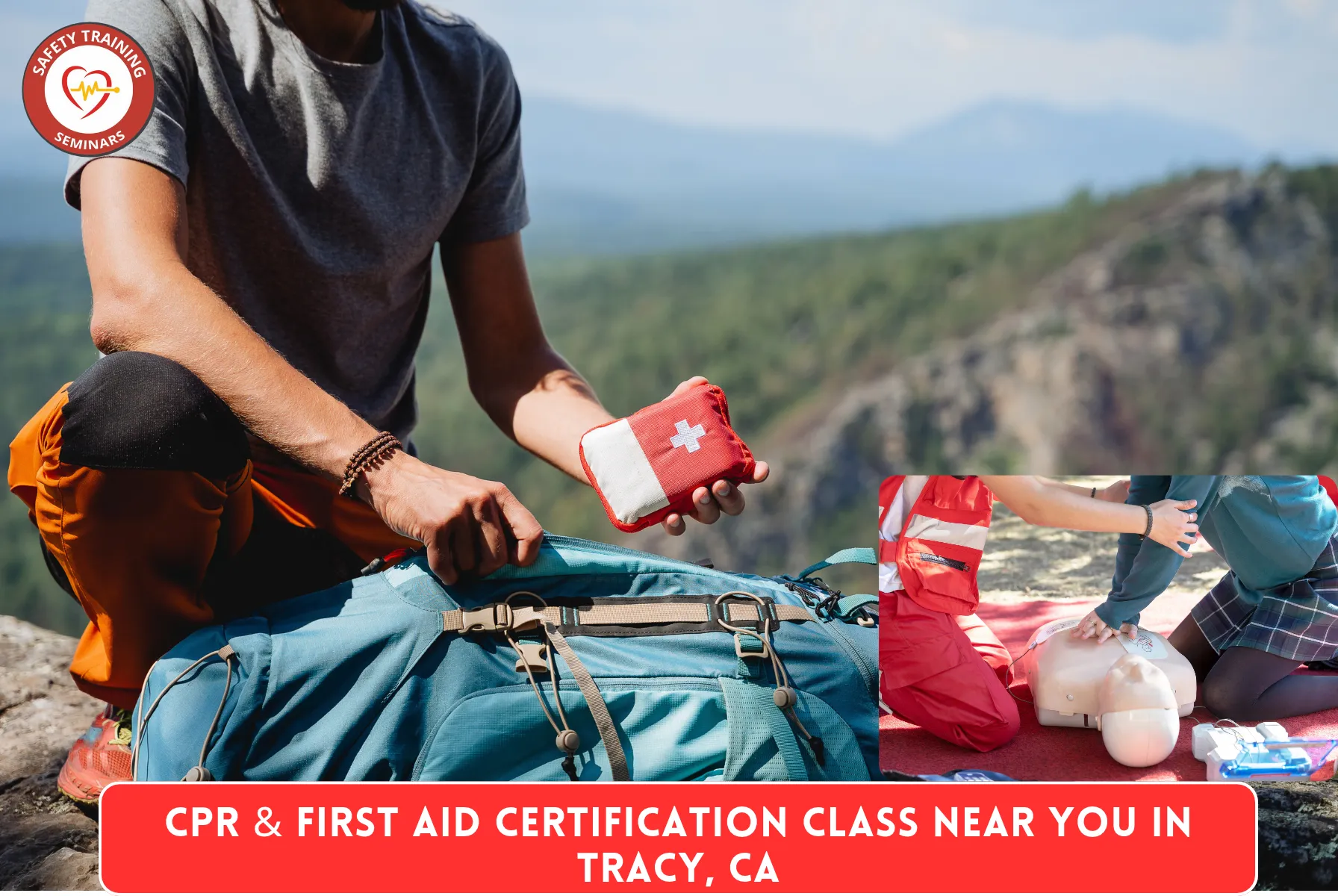
A CPR and First Aid course pairs two kinds of emergency response. It helps to understand them separately, because some requirements call for one half more than the other.
The CPR and AED half
Cardiopulmonary resuscitation (CPR) is the combination of chest compressions and, in some courses, rescue breaths used when a person’s heart stops pumping effectively. Training teaches you to recognize cardiac arrest (a person who is unresponsive and not breathing normally), call 911, begin compressions, and use an automated external defibrillator (AED). An AED is a portable device that analyzes the heart’s rhythm and, when appropriate, prompts the user to deliver a shock. Choking response for adults is also part of this skill set.
The first aid half
First aid covers the injuries and sudden illnesses that happen far more often than cardiac arrest. The American Heart Association (AHA) Heartsaver First Aid CPR AED course includes first aid basics, medical emergencies, injury emergencies, environmental emergencies, preventing illness and injury, and recognizing signs of a heart attack or stroke. Injury topics include bleeding, sprains, broken bones, and shock.
The AHA designs Heartsaver for people with little or no medical training who need a completion card for their job, for a regulatory requirement such as OSHA, or for personal preparedness. Adult CPR is standard, and child and infant CPR are available as optional modules. Training prepares you to help until emergency medical services arrive; it is not a substitute for professional medical care.
Tracy’s Distribution Floors and Why Employers Ask
Tracy’s economy is primarily dependent on manufacturing, distribution, and logistics. Transportation and logistics is San Joaquin County’s fastest-growing business, and corporations with significant distribution operations in the city include Amazon, Costco, and Safeway. Cuts, strains, heat illness, and unexpected medical crises are all possible in the Central Valley due to large facilities, lengthy shifts, forklifts, conveyors, and summer heat.
California’s workplace regulations specifically address this. According to Title 8 section 3400 of Cal/OSHA’s General Industry Safety Orders, one or more individuals must be properly trained to provide first aid where there isn’t a hospital, clinic, or infirmary nearby that can treat wounded workers. Each employer determines how to comply with the rule because it does not provide a specific course.
For this reason, Tracy frequently tells a warehouse lead, shift supervisor, or member of the safety committee to “get CPR and First Aid.” Ask your safety coordinator three questions before registering: if you need a card from a particular organization, if you need to perform CPR on children and infants, and if you may enrolll in an online-only course. The majority of job requirements call for practical abilities.
When the Job Is Clinical, BLS Usually Comes First
Healthcare workers in and around Tracy follow a different track. Sutter Tracy Community Hospital, at 1420 North Tracy Boulevard, operates the area’s only emergency department staffed around the clock and serves as a primary stroke center. Nearby, Kaiser Foundation Hospital Manteca and San Joaquin General Hospital in French Camp serve the wider south county.
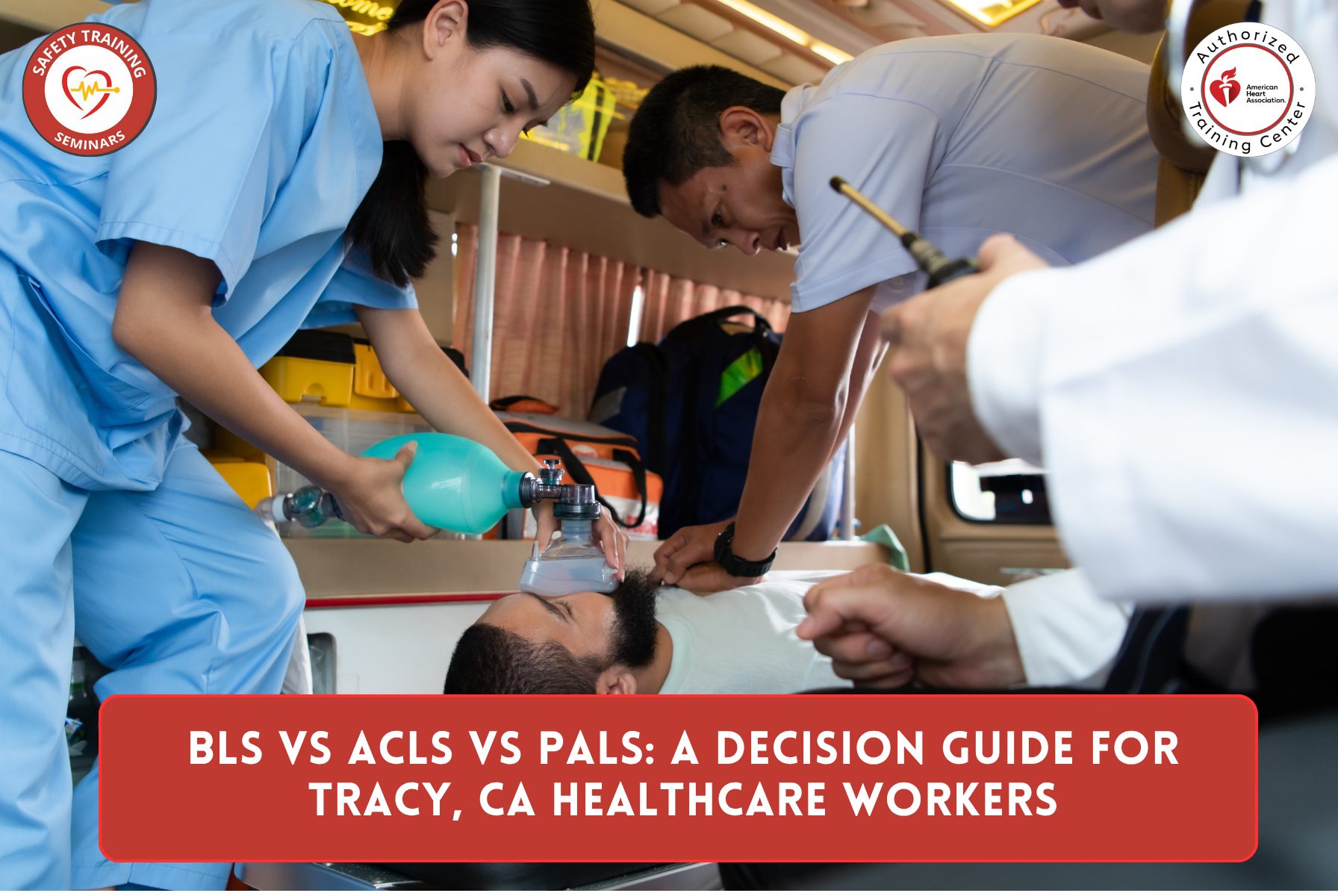
Nurses, nursing assistants, medical assistants, dental teams, and EMTs working in clinical settings are typically asked for Basic Life Support (BLS), the AHA course for healthcare providers. BLS focuses on high-quality CPR for all ages, AED use, and coordinated multi-rescuer resuscitation. It does not include the broader first aid topics found in Heartsaver, and a Heartsaver card generally does not satisfy a BLS requirement.
Nursing students from Tracy feel this most directly. San Joaquin Delta College in Stockton, the nearest community college nursing program for many Tracy residents, states in its catalog that the only CPR card accepted for its Associate Degree in Nursing program is AHA BLS for Healthcare Providers, and that online CPR courses are not accepted. If you are heading into a clinical program, confirm the exact requirement before booking anything labeled “CPR and First Aid.”
Classrooms, Daycares, and Ballfields
Outside healthcare and logistics, CPR and First Aid training shows up in quieter ways.
- Childcare providers: California’s Health and Safety Code section 1596.866 requires regulated child care facilities to have at least one person on site with current pediatric first aid and pediatric CPR training whenever children are present. That training must meet Emergency Medical Services Authority (EMSA) standards, so a general workplace card may not qualify. Confirm the course with your site director.
- School staff: Teachers, aides, and campus staff may be asked to complete training by their district or school. Requirements vary by role, so check with your administrator.
- Coaches and fitness professionals: Youth sports organizations and gyms often set their own standards, and AED skills are especially relevant in public facilities.
- Parents and caregivers: No requirement applies, but families with infants or toddlers often prefer a course that includes child and infant CPR.
How to Read a Course Listing Before You Book
Course names can be close enough to cause mix-ups. When you look at any listing, check these details against your requirement:
| What to check | Why it matters |
| Exact course title | “Heartsaver First Aid CPR AED” and “BLS” are different courses with different audiences |
| Issuing organization | Some employers and programs accept only AHA cards; others accept any provider |
| Age groups covered | Childcare, school, and family settings often need child and infant CPR |
| Hands-on skills session | Many workplace and program requirements expect in-person skills verification |
| Completion documentation and validity | AHA Heartsaver First Aid CPR AED cards are valid for two years |
When in doubt, the written requirement from your employer, school, or licensing contact is the final word.
Safety Training Seminars in Tracy
Safety Training Seminars operates its Tracy CPR Training Center at 902 N Central Ave, Suite 219, Tracy, CA 95376. The classroom is on the second floor of the corner building at North Central Avenue and East 9th Street, in central Tracy, and the center also serves learners from nearby communities such as Mountain House.
For people comparing options for a CPR & First Aid certification class in Tracy, the center lists general-public choices that include:
- AHA Heartsaver CPR and First Aid, covering CPR for all age groups, AED use, bleeding control, and epinephrine auto-injector use, which combines an AHA online course with a hands-on skills test and leads to an AHA Course Completion eCard
- Safety Training Seminars CPR and First Aid, a company-issued option for learners who do not need AHA documentation
Healthcare learners can also find AHA BLS, ACLS, PALS, and NRP courses through the same center. Schedules, pricing, and formats change, so check the official course page for current details.
Questions Tracy Learners Often Ask
Do warehouse employees in Tracy have to take CPR and First Aid?
Not automatically. Cal/OSHA requires adequately trained first aid personnel when an infirmary, clinic, or hospital is not in near proximity, and each employer decides how to meet that. Your safety coordinator or HR department can tell you whether your role requires training and which course is accepted.
I’m applying to the Delta College nursing program. Will a CPR and First Aid card count?
No. San Joaquin Delta College accepts only AHA BLS for Healthcare Providers for its ADN program and does not accept online CPR courses.
Does a CPR and First Aid course include infant CPR?
It depends on the course. In AHA Heartsaver First Aid CPR AED, child and infant CPR are optional modules, so confirm they are included if you work with young children or need them for a requirement.
What do I receive after completing an AHA Heartsaver course?
Learners who complete all course requirements receive an AHA Heartsaver First Aid CPR AED course completion card, valid for two years.
Can I take the course in Tracy if I live in Mountain House, Lathrop, or Manteca?
Yes. Registration is open to anyone, regardless of which city you live in.
Does finishing the course make me a professional first responder?
No. A completion card documents that you finished a training course. It is not a professional license, and acceptance always depends on the employer, school, or agency that set the requirement.
Your Next Step
Start with the person or program asking for the card. If you work a clinical role or are entering a nursing program, plan on BLS. If you work with young children in a regulated setting, look for EMSA-approved pediatric training. For most warehouse teams, office staff, coaches, and families, a CPR and First Aid course with hands-on skills practice is the right fit. Once you know which course you need, review the current Tracy CPR & First Aid certification course options and pick a session that fits your shift schedule.