Healthcare professionals in San Joaquin County face a common challenge when renewing credentials or onboarding at local medical facilities: selecting the precise life support certification required for their specific clinical scope. While Advanced Cardiovascular Life Support (ACLS) and Pediatric Advanced Life Support (PALS) build upon basic resuscitation concepts, taking the wrong course can result in rejected onboarding paperwork, unexpected out-of-pocket expenses, and delayed start dates.
Determining whether you need a Basic Life Support (BLS) CPR Certification Course, ACLS, or PALS depends entirely on your patient population, clinical environment, and licensing requirements. Nurses at Sutter Tracy Community Hospital, outpatient surgical staff, emergency medical technicians, and pediatric care teams all operate under distinct regulatory standards. This guide breaks down the core clinical differences, target audiences, and prerequisite chains for each course so you can enroll in the correct class with confidence.
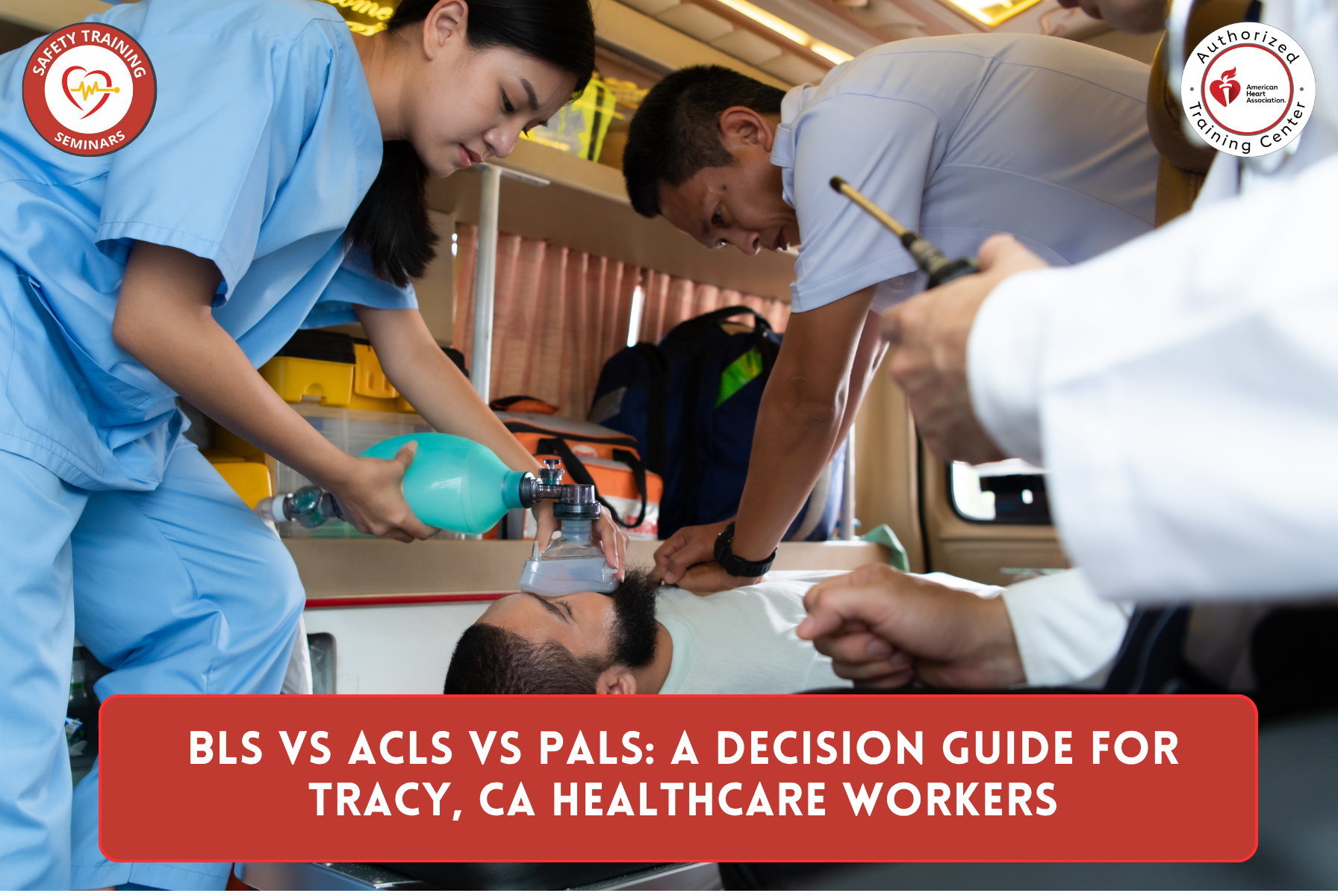
Key Takeaway: BLS focuses on high-quality CPR, airway management, and AED use for adult and pediatric patients in any clinical setting. ACLS expands this focus to adult cardiovascular pharmacology, ECG rhythm interpretation, and airway control for critical care providers. PALS targets specialized pediatric assessment, resuscitation algorithms, and emergency care for infants and children.
Understanding Basic Life Support (BLS)
Basic Life Support serves as the foundational resuscitation standard for healthcare workers across all disciplines. Unlike lay-responder CPR classes designed for workplace compliance, BLS training focuses on team-based resuscitation within clinical environments.
The BLS curriculum teaches single-rescuer and team resuscitation strategies for adult, child, and infant cardiac arrest scenarios. Key clinical components include:
- High-yield chest compressions with minimal interruptions
- Multi-rescuer bag-mask ventilation techniques
- Automated External Defibrillator (AED) integration for adult and pediatric patients
- Rapid relief of foreign-body airway obstructions for conscious and unconscious victims
Who Needs BLS in Tracy?
BLS certification is mandatory for almost every credentialed healthcare worker. This includes registered nurses (RNs), licensed vocational nurses (LVNs), certified nursing assistants (CNAs), dental hygienists, physical therapists, radiologic technologists, and students enrolled in local health science programs. If you are entering the medical field, BLS is the universal baseline requirement.
Advanced Cardiovascular Life Support (ACLS) Explained
ACLS moves beyond high-quality CPR to focus on the advanced management of adult cardiovascular emergencies. Participants learn to manage pre-arrest conditions, acute ischemic stroke, acute coronary syndromes, and active cardiac arrest within an interprofessional resuscitation team.
The course emphasizes systematic clinical decision-making using the American Heart Association (AHA) ECC algorithms. Key competencies include:
- Electrocardiogram (ECG) rhythm recognition for bradycardias, tachycardias, and lethal arrhythmias
- Airway management using advanced devices such as endotracheal tubes and supraglottic airways
- Resuscitation pharmacology, including proper dosing and administration of epinephrine, amiodarone, and adenosine
- Electrical therapies, including manual defibrillation, synchronized cardioversion, and transcutaneous pacing
Who Needs ACLS?
ACLS is required for healthcare providers who direct or participate in the management of adult peri-arrest and cardiac arrest events. Critical care nurses, emergency department personnel, ICU staff, telemetry nurses, surgical teams, paramedics, and hospital-based physicians must maintain active ACLS credentials alongside their BLS certification.
Pediatric Advanced Life Support (PALS) Overview
Pediatric emergencies require a clinical approach distinct from adult resuscitation due to fundamental anatomical, physiological, and developmental differences. PALS equips providers with the skills necessary to initiate and direct advanced care during pediatric respiratory, shock, and cardiac emergencies.
The curriculum utilizes a systematic assessment model to evaluate critically ill infants and children rapidly. Core clinical priorities include:
- Early identification and intervention for respiratory distress and failure
- Management of compensated and hypotensive shock using fluid resuscitation and vasoactive infusions
- Advanced pediatric airway management and vascular access techniques, including intraosseous (IO) placement
- Execution of pediatric resuscitation algorithms for bradycardia, tachycardia, and cardiac arrest
Who Needs PALS?
PALS certification is designed for clinicians who care for pediatric patients in acute, emergency, or critical care environments. This group includes pediatric nurses, emergency department staff, urgent care clinicians, pediatric ICU personnel, paramedics, respiratory therapists, and pediatric dental specialists.
Comparing BLS, ACLS, and PALS: Key Differences
Selecting the correct certification requires comparing how each course aligns with your clinical duties. While BLS concentrates on mechanical resuscitation skills, ACLS and PALS focus heavily on diagnostic assessment, advanced airway placement, and clinical pharmacology.
| Feature / Standard | Basic Life Support (BLS) | Advanced Cardiovascular Life Support (ACLS) | Pediatric Advanced Life Support (PALS) |
| Primary Patient Focus | Adult, Child, & Infant | Adult | Infant & Child |
| Prerequisites | None (Introductory) | Current BLS & ECG Interpretation | Current BLS & Pediatric Pharmacology |
| Core Competency | CPR, AED, & Ventillations | ECG, Airway, & Pharmacology | Pediatric Assessment & Shock Management |
| Advanced Airway Skills | Basic Bag-Mask Ventilation | ET Tube & Supraglottic Devices | ET Tube & IO Access Integration |
| Clinical Scope | All Healthcare Providers | Critical Care, ED, & Urgent Care | Pediatrics, ED, & PICU Staff |
How to Determine Which Certification You Need
Employers, academic institutions, and state licensing boards set certification standards based on patient safety protocols and clinical risk levels. To avoid enrolling in an unapproved or incorrect course, walk through these three verification steps:
- Review Your Job Description or Unit Policy: Hospital units enforce strict certification matrices. Floor nurses in med-surg units usually only require BLS, whereas telemetry or step-down units require ACLS.
- Identify Your Primary Patient Demographic: If your patient load consists of adults, ACLS covers your advanced track. If you regularly manage pediatric patients, PALS is required. Emergency department staff frequently need all three certifications.
- Verify Provider Recognition: Healthcare facilities almost universally mandate American Heart Association (AHA) training. Confirm whether your employer accepts blended learning formats (online coursework paired with an in-person skills verification) or requires traditional classroom sessions.
Facilities like Sutter Tracy Community Hospital and surrounding regional clinics strictly enforce AHA-compliant credentials for onboarding and annual credential reviews.
Prerequisites for Advanced Resuscitation Courses
Enrolling directly into an ACLS or PALS course without proper preparation can lead to difficulty during testing scenarios. Both advanced tracks build upon basic skills and assume immediate mastery of fundamental resuscitation.
Prerequisites for ACLS
To succeed in an ACLS class, you must hold a current BLS certification. You must also be able to identify basic ECG rhythms (including sinus bradycardia, ventricular tachycardia, ventricular fibrillation, asystole, and heart blocks) and understand basic resuscitation medications prior to attending class.
Prerequisites for PALS
PALS candidates must hold a current BLS card and complete pre-course assessment modules covering pediatric medication dosing, vital signs by age group, and pediatric algorithm flows.
Life Support Certification for Healthcare Professionals in Tracy, CA
Healthcare providers working in San Joaquin County face unique scheduling demands, particularly those commuting between local outpatient clinics, community hospitals, and regional medical centers. Having access to responsive, locally accessible training helps clinicians maintain uninterrupted employment status.
Medical staff residing in Tracy or commuting from nearby communities often manage strict renewal windows mandated by the California Board of Registered Nursing (CBRN) or local EMS authorities. Choosing a nearby training center eliminates unnecessary travel and allows professionals to complete hands-on skills evaluations efficiently.
Whether you reside locally in Tracy or commute from neighboring cities like Manteca, Lodi, Lathrop, or Mountain House, securing an official AHA certification card on the day of class keeps your professional credentials completely up to date.
Resuscitation Training at Safety Training Seminars Tracy
Safety Training Seminars provides official American Heart Association (AHA) certification courses tailored to meet the needs of local healthcare workers, students, and clinical teams.
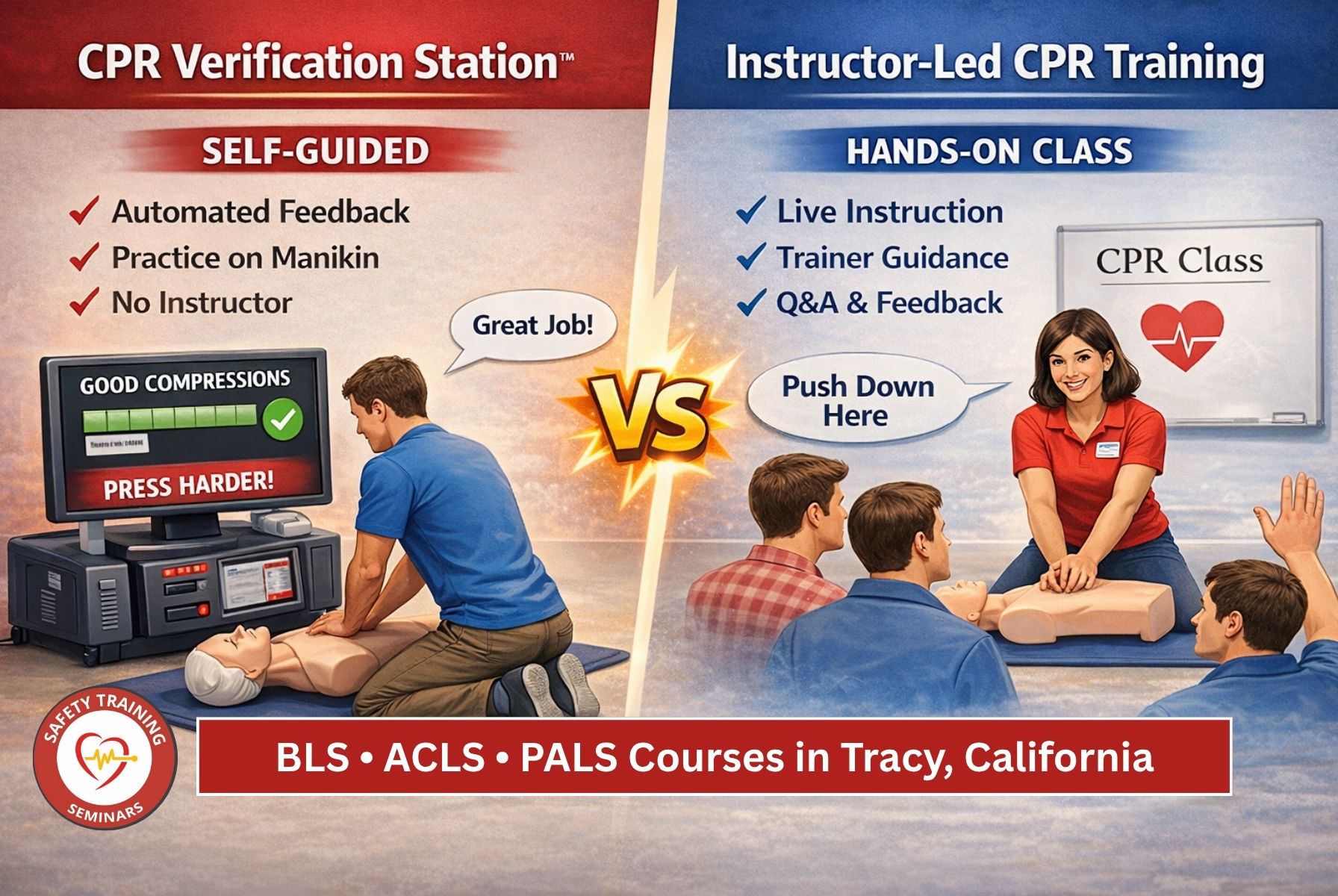
Courses feature flexible scheduling options, including blended eLearning formats where didactic coursework is completed online followed by a rapid, hands-on skills evaluation at the physical facility.
Safety Training Seminars : 902 N Central Ave, Suite 219,Tracy, CA 95376
Clinicians seeking certification can view class options for surrounding service areas:
- Healthcare workers traveling from the east can review Manteca AHA CPR and BLS certification schedules.
- Clinicians serving northern San Joaquin County can check Lodi life support training courses.
- Commuters along the I-5 and I-205 corridors can check Lathrop CPR and ACLS class options or review updates for Mountain House healthcare training schedules.
Frequently Asked Questions
Can I take ACLS or PALS without a current BLS certification?
No. High-quality BLS CPR skills are the foundation of all advanced resuscitation courses. Most training centers require you to present a valid BLS provider card before attending an ACLS or PALS course. Many facilities offer combined renewal options so you can complete both requirements during a single session.
How long are AHA BLS, ACLS, and PALS certifications valid?
All official American Heart Association provider certifications are valid for two years from the last day of the month in which the course was completed. To maintain active status, clinicians must complete a renewal course prior to the card’s expiration date.
Are online-only CPR certificates accepted by Tracy healthcare facilities?
Most major medical centers, including hospital networks and surgical centers in San Joaquin County, do not accept 100% online CPR cards that lack an in-person, hands-on skills verification. Official AHA blended courses combine online learning with an in-person instructor check to satisfy employer standards.
How far in advance should I book my recertification in San Joaquin County?
It is best to register for recertification 30 to 45 days before your credential expires. Scheduling early ensures you secure a time slot that fits your shift schedule and prevents compliance lapses that could temporarily restrict you from working clinical shifts.
Conclusion
Choosing between BLS, ACLS, and PALS comes down to your clinical role, employer expectations, and patient population. BLS provides essential life support skills for all healthcare workers, while ACLS and PALS deliver advanced training for adult and pediatric critical care settings. Securing the correct American Heart Association credential ensures full compliance with institutional policies and licensing standards across California.
Healthcare professionals in Tracy, Manteca, Lodi, Lathrop, and Mountain House can maintain their professional credentials without disrupting their work schedules. Review current course availability, verify your prerequisite requirements, and select the appropriate training track at the Safety Training Seminars Tracy training center to keep your certifications active.